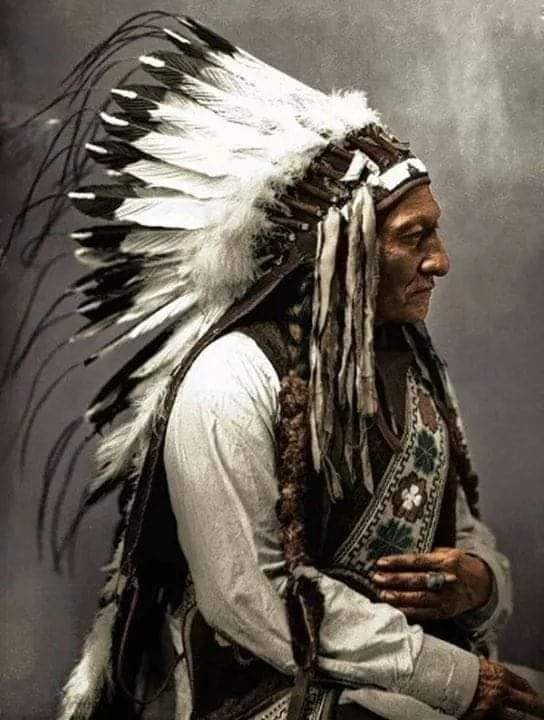
HOW SITTING BULL GOT HIS NAME
By White Bull
When Sitting Bull was about six years of age his folks were living on the banks of Grand River. Like all Lakota lads he was taught to get upearly and attend to the horses, learn to ride, to shoot with bow and arrow, swim, play all kinds of games, sing and dance and if occasion demands to go hunting or on the war-path. One morning just about daybreak, Sitting Bull whose nickname hunkesni — meaning Slow, woke up to look for horses. This he did on footand had the grand opportunity to observe everything on the way, the singing of birds, the howling of coyotes, deer watering on the river bank and infact everything that nature offered.He was enjoying this morning’s hike immensely, and was singing andhumming some new tune he had heard recently for he was a great lover of music. Just as had reached a high hill, viewing the scenery all round him he heard some kind of a noise and looking down he saw a buffalo bull in a sitting position. Hunkesni did not have any weapon of any kind so became scared — stood there in awe — but the bull was looking at him in such a manner that he could not break away from it. But the bull did not show any sign of harming him. At last, the bull resumed its natural position, lifted up its tail, pawed upon the ground and quietly went its way. Hunkesni was glad that he was not harmed by the animal, gave another look at it and said, “Tatanka Iyotake unsimayala yelo — pili mayayelo, –ohocila kta.” “Sitting Bull, you’ve pitied me– thank you. I respect you.”
Finding the horses he went home and related about the bull to his father. His father called the camp crier and ordered him to proclaim to the people, owing to this strange incident between the boy and the animal, that at from that day hence, Hunkesni shall be known as Tatanka Iyotaka-SittingBull.
❤Sitting Bull was the first man to become chief of the entire Lakota Sioux nation.
Sitting Bull was born around 1831 into the Hunkpapa people, a Lakota Sioux tribe that roamed the Great Plains in what is now the Dakotas. He was initially called “Jumping Badger” by his family, but earned the boyhood nickname “Slow” for his quiet and deliberate demeanor. The future chief killed his first buffalo when he was just 10 years old. At 14, he joined a Hunkpapa raiding party and distinguished himself by knocking a Crow warrior from his horse with a tomahawk. In celebration of the boy’s bravery, his father relinquished his own name and transferred it to his son. From then on, Slow became known as Tatanka-Iyotanka, or “Sitting Bull.”
Sitting Bull was renowned for his skill in close quarters fighting and collected several red feathers representing wounds sustained in battle. As word of his exploits spread, his fellow warriors took to yelling, “Sitting Bull, I am he!” to intimidate their enemies during combat. The most stunning display of his courage came in 1872, when the Sioux clashed with the U.S. Army during a campaign to block construction of the Northern Pacific Railroad. As a symbol of his contempt for the soldiers, the middle-aged chief strolled out into the open and took a seat in front of their lines. Inviting several others to join him, he proceeded to have a long, leisurely smoke from his tobacco pipe, all the while ignoring the hail of bullets whizzing by his head. Upon finishing his pipe, Siting Bull carefully cleaned it and then walked off, still seemingly oblivious to the gunfire around him. His nephew White Bull would later call the act of defiance “the bravest deed possible.”
 Natives Network
Leave a comment