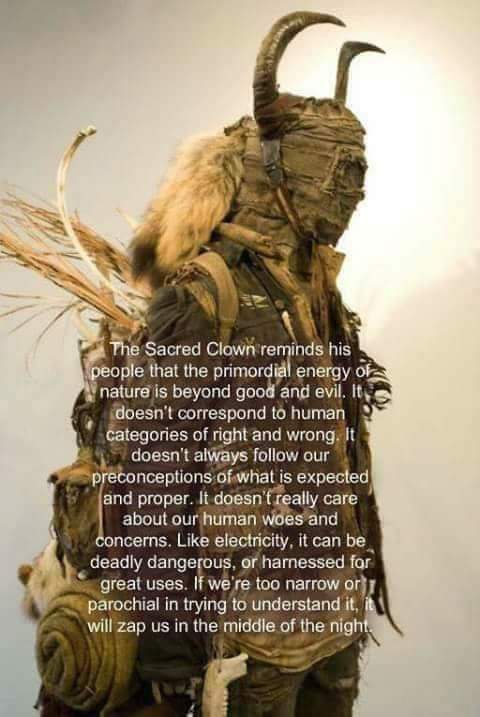
The Sacred Clown
Most every tribe had their Clowns. The Oglala and Lakota called them Heyoka (crazy) the Arapaho called them Ha Hawkan (Holy idiot) and both peoples considered them religious specialists.
The Salish people honor the memory of a Clown who (not so long ago) challenged a missionary. The missionary was enticing people to come to his church by handing out little mirrors to them while urging them to cover their bodies with white folks’ clothes. It is told with a smile that the Clown (a woman) walked into the church one sunday wearing nothing but a hat and old shoes!
The Hopi protected their sacred clowns by incorporating them into their Kachina (cloud spirit) ceremonies where the clowns make a hilarious entrance from a roof, descending a rope ladder into the plaza where the Kachinas are dancing.
“Look down there!” they exclaim, “Everything is bountiful and beautiful!” Their descent is very precarious, usually head-first, and causes much laughter as they tumble over each other and fall the last few feet. They do not see the Kachinas until they bump into them, and then they say “This is mine!” or “This many are mine!” They act silly, childish, greedy, selfish,and lewd. As they pretend to become aware of their surroundings, they mock tourists, anthropologists, neighboring Indians, even themselves! They beg for food. Their guessing games and balancing acts please the crowds. The dancing Clowns sometimes pretend they are invisible, heightening the joke.
The survival of these ritual clowns gives us a clue as to how important a clown was to the community-spirit of each Native American tribe. Nothing was sacred to the sacred clown. she was a social critic of the highest order. Her funny mimicry and joking exposed hypocrisy and arrogance. Her portrayals of ridiculous behavior showed the people (in a very humorous way) their own fooishness and blind-spots. ” A clown was like a newspaper, or a magazine, or one of thsoe people who write an article to tell you if a book or a movie is worth bothering with. They made comment of everthing, every day, all the time. If a clown thought that what the tribal council was getting ready to do was foolish, why the clown would just show up at the council and imitate every move every one of the leaders made. Only the clown would imitate it in such a way every little wart on that person would show, every hole in their idea would suddenly look real big.
A negative religious figure (such as the sacred clown) seems odd to most non-tribal people. Most Native Americans, how, LOVE the humor of it and tell stories about a mythic trickster whose pranks and mishaps teach the tribe moral lessons. The Trickster takes many forms, but the favorites seem to be animals who are exceptionally curious, resourceful and adaptable-SURVIVORS, such as spider, raven, rabbit, owl, bat, coyote and crow. The stories are full of funny situations with th trickster being mischievous, being in turn made a fool of, and even getting involved in obscene affairs. “Mostly, Trickster likes pullin’ antics and tellin dirty jokes”perhaps it is this appreciation for the trickster that has given the Native American the ability to survive against all odds. The Trickster makes a lot of mistakes, and usually has a had time learning from them. However, she keeps on keepin’on. She doesn’t drown herself in despair, doesn’t kill herself in frustration. she survives.
Trickster shows us how we trick OURSELVES. Her rampant curiosity backfires, but, then somethin new is discovered (though usually not what she expected) This is where creativity comes from-experiment, do something different maybe even something forbidden, and voila. A breakthrough occurs! We are released!~ The world is created a new! Do something backwards, break your own traditions, the barrier breaks, destroy the world as you know it, let the new in.
What is truth? This question propels the Clown into the sacred dimension. The Truth the Clown intuits is the interconnectedness of all life. She knows (although she cannot prove)) that no part is more important than any other part-no matter how big or how small-and that the tiniest change in one part produces a profound change in the whole.
If you decide to travel on this path with a heart, you’ll be traveling backwards! Remember, though, to look behind you ( or in front of you) once in a while,. It just could be that another sacred clown is clowning you up! and that could be worth a good belly laugh for sure.
 Natives Network
Leave a comment